
Minerals in the Secrets of the Oceans – April 26
MRK Mining | Avril/April 2026 Numéro/Issue No. 5 |
Minerals in the Secrets of the Oceans
 On March 8, 2014, Malaysia Airlines Flight MH370, departing from Kuala Lumpur bound for Beijing, suddenly disappeared from Malaysian and Vietnamese radar screens shortly after takeoff, resulting in the disappearance of 239 people on board. After search and rescue operations between 2015 and 2016, several pieces of marine debris that washed ashore in the western Indian Ocean (as far as the Maldives and Seychelles) were identified as originating from this aircraft. An oceanographer interviewed about this tragic incident stated that the ocean has not yet revealed its true nature despite today’s considerable technological advances.
The ocean still holds many mysteries, both in terms of how it functions and the species it harbors. In their quest for knowledge, scientists are particularly focused on the deep sea. The surfaces of the Moon (notably with the recent Artemis II mission) and Mars have already been mapped, yet the oceans remain a true terra incognita. Deep-sea environments are still often considered flat and devoid of life. However, this has not prevented humans from discovering metals in these abysses.
The strong demand for critical metals for the energy transition and the green revolution captivates the human imagination. Exploiting land-based resources is no longer sufficient; we must dig elsewhere. Today, geologists, mining companies, and investors are turning toward the abyss—an unknown and dark world. The mining industry is already often described as opaque, and if it expands into the oceans, this perception will take on an even deeper meaning, as humans have very limited knowledge of the depths of seas and oceans, which cover more than two-thirds of the Earth’s surface. From an economic standpoint, however, deep-sea mining is seen as a potential response to the growing demand for strategic metals and could represent a way to diversify global supply.
Seafloors of which only 20% have been mapped and less than 5% explored! Abysses where there is no light, and for centuries, it was firmly believed that no life existed there. As the French humanist, biologist, and explorer Théodore Monod wrote: “It is dark, it is cold, it is deep, and there is hunger.”
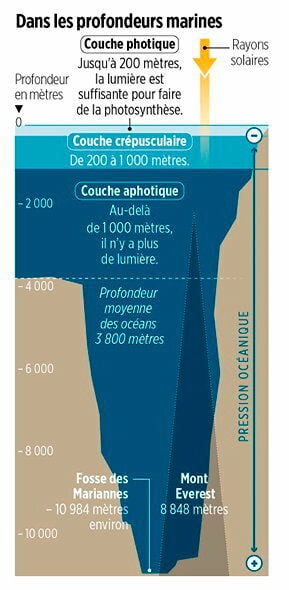
Why? Because at depths of several thousand meters, the pressure is so extreme that only a handful of scientific submarines and advanced equipment can reach them. For a long time, these depths were considered a complete desert because sunlight—the original source of life on land through photosynthesis—does not reach there. However, in 1952, a sample taken by the Danish oceanographic vessel Galathea in the Tonga-Kermadec Trench in the Pacific confirmed the presence of animals—mainly mollusks and crustaceans—at depths exceeding 10,000 meters.
What seemed to be an inhospitable landscape turned out to be a dynamic and delicate ecosystem. The seafloor mainly consists of abyssal plains—homogeneous environments characterized by vast flat expanses covered with mud. This soft and unstable sediment is easily stirred, creating sediment clouds. It is in these areas that we find three main sources of minerals: (1) polymetallic nodules (containing manganese, nickel, copper, cobalt, and traces of rare minerals), (2) cobalt-rich crusts (containing cobalt, manganese, nickel, lithium, and rare earth elements) and (3) polymetallic sulfides (containing copper, zinc, silver, and gold) (Source: United Nations Scientific Advisory Board – Seabed Mining Process Map (George Shouha).
What are polymetallic nodules?
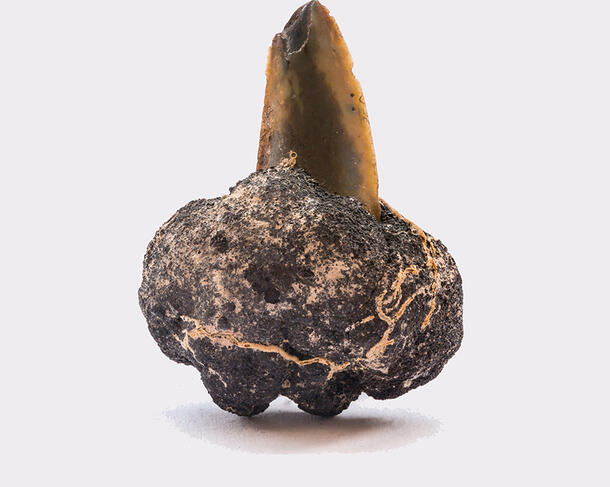 Polymetallic nodules are mineral deposits that form slowly on the ocean floor, layer by layer, over millions of years through the precipitation of chemical elements. They form at an extremely slow rate—just a few millimeters per million years—and their formation may be linked to the activities of certain microorganisms. (The polymetallic nodule in this picture was formed from a shark tooth located at 5000 meters deep in the Pacific Ocean). About the size of a tennis ball, these nodules grow very slowly, at a rate of a few millimeters per million years. “Polymetallic nodules from the abyssal plain, cobalt-bearing crusts, and polymetallic sulfides from hydrothermal vents are attracting interest from industries—particularly those involved in the energy transition—that are seeking new mineral resources,” notes Sophie Gambardella, a legal scholar at the Laboratory of International, Comparative, and European Law, a joint CNRS/Aix-Marseille University Unit.
These nodules and crusts are spread across vast areas of the seafloor, particularly in the Clarion-Clipperton Zone (CCZ), often referred to simply as “The Zone,” where concentrations are especially high. They resemble small stones but are actually deposits of mineral wealth.
The Zone
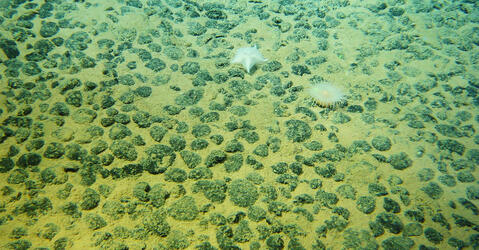 The ZCC has been identified as the crown jewel of polymetallic nodules (pictured here), a six-million-square-kilometer maritime area encompassing vast expanses, of which only 30 square kilometers of abyssal plains have been studied. The Zone is located between Mexico and Hawaii in the heart of the northeastern Pacific in an area outside national jurisdiction, meaning it belongs to no state. Estimates from the U.S. Geological Survey indicate that the Clarion-Clipperton Zone, a region the size of the European Union, contains 21 billion tons of nodules. This zone, being explored by The Metal Company, a Canadian firm, is believed to hold more cobalt and nickel than all land-based mines combined.
From a jurisdictional standpoint, the ocean floor and subsoil fall within the international seabed area under the Montego Bay Convention. In accordance with the United Nations Convention on the Law of the Sea, the Zone and its mineral resources constitute the common heritage of mankind. Any exploration or exploitation activity in that area must be conducted under a contract with the International Seabed Authority (ISA) and in accordance with the rules, regulations, and procedures established by the ISA. Consequently, any claim or exercise of sovereignty or sovereign rights over any part of the Zone or its resources, as well as the appropriation, alienation, or exercise of any rights relating to minerals extracted from the Area, is prohibited for any State or any natural or legal person.
The International Seabed Authority
The International Seabed Authority (ISA), headquartered in Kingston, Jamaica, is an autonomous international organization established under the 1982 United Nations Convention on the Law of the Sea (UNCLOS) and the 1994 Agreement relating to the Implementation of Part XI of the United Nations Convention on the Law of the Sea (1994 Agreement). It became fully operational as an autonomous international organization in June 1996. As of February 6, 2026, the ISA had 172 members. Its exclusive role is to regulate activities in the Area under international law. Brazilian oceanographer, Leticia Carvalho, is the current Secretary-General.
While the management of territorial or state waters falls under the jurisdiction of each State, which has full sovereignty over the airspace, the entire body of water, the seabed, and the subsoil, the high seas, also known as international waters, is an area covering more than 60% of the oceans and is not under the authority of any state; therefore, in theory, it belongs to no one, but its ambiguous status is governed by international treaties that are poorly harmonized and insufficiently protective. Consequently, the AIFM is responsible for regulating activities conducted in the deep seabed located beyond the national jurisdictions of coastal states.
Exploration Attempts
 In October 2022, the vessel Hidden Gem carried out the first large-scale collection of deep-sea minerals. The Metals Company retrieved 4,500 tons of polymetallic nodules from about 4 km depth. However, the feasibility and profitability of such operations remain uncertain.
Are We Technologically Ready?
The machines used for exploration already exist. We’re talking about machines that look like a sort of harvester hooked up to a giant vacuum cleaner. The machine collects the nodules, sucks them up, and brings them to the surface through a hose connected to a ship. But keep in mind, we’re talking about a depth of 4,500 meters. A very powerful pump is needed to bring up what could be compared to metal tennis balls. This requires an enormous amount of energy. Thanks to technology, “the autonomous and remotely operated underwater vehicles we have can now operate at depths of up to 6,000 meters for dozens of hours,” said Gérard Barron, President and CEO of Metal Company.
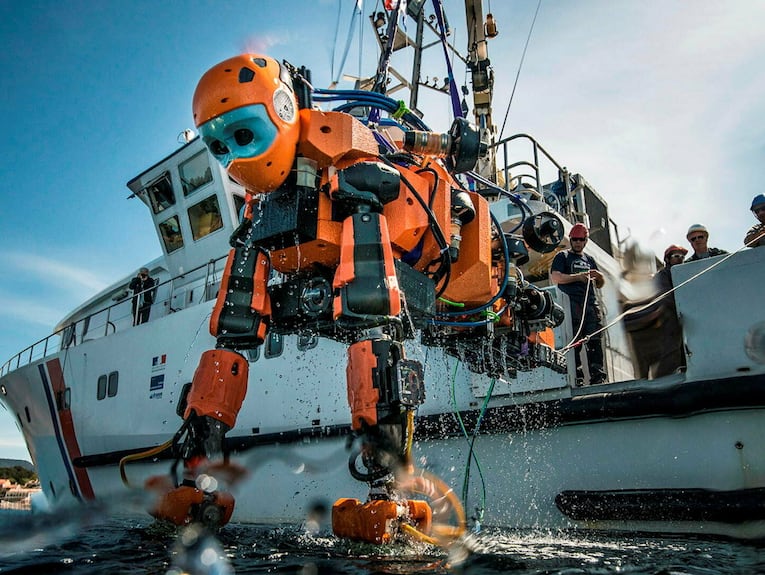
The humanoid robots developed by Ifremer (pictured above) and other cutting-edge laboratories, including OceanOne, are making the deep sea—where conditions are so extreme that no diver can venture there—accessible. They enable exploration of the seafloor for dozens of hours, navigating through shipwrecks, mapping the seabed, observing marine life on the ocean floor, monitoring underwater volcanoes or faults, and even the collection of samples to advance scientific research. These underwater robots are also proving indispensable for the deployment and maintenance of observatories on the ocean floor, as they are the only devices capable of helping scientists understand the real-time functioning of deep-sea ecosystems
Major Challenges
Seabed mining raises social, environmental, and governance issues, as it could affect coastal communities toward which plumes might drift—or even the entire planet.
- Who decides?
- Who has the right to exploit these resources?
- Since these resources belong to all of humanity, how should we share the benefits derived from resources located in international waters, given that everything extracted must be shared equitably among nations? “Developed countries believe that transferring technology and capacity to countries in the Global South is the right model. Southern countries, on the other hand, would prefer to combine monetary and non-monetary distribution,” explains Sophie Gambardella, a researcher at the International, Comparative, and European Law Laboratory, highlighting the ambiguity of the issue of seabed mining.
- How can we collectively manage such a strategic and sensitive resource without solid rules?
Scientific and Economic Impasse
- Lack of scientific knowledge – While the AIFM must decide soon on the issue of deep-sea mining, some twenty countries are recommending a precautionary pause—until more is known about this environment. The current seven-year moratorium was initiated and signed by approximately thirty countries, including New Caledonia.
- As fascinating as they may be, these marine environments remain very difficult to study – Unlike terrestrial ecosystems, the deep seabed remains largely unexplored; its biological dynamics are poorly understood, and the resilience of its ecosystems to disturbances is uncertain.
- Economic viability – It requires costly and complex technologies (underwater robots, specialized vessels, specialized processing systems, etc.), and no commercial project has, to date, proven its profitability.
On the legal front – no Mining Code
Beyond economic and environmental considerations, deep-sea mining raises diplomatic and regulatory tensions. To date, the AIFM has issued only exploration contracts, and no commercial mining permits have been granted. The lack of clear rules on the granting of mining licenses and disagreements among States are slowing the adoption of a Mining Code, which is the subject of the AIFM’s annual negotiations. Debates are heated on several points of the future mining regime: environmental standards, benefit-sharing systems, liability for ecological damage, monitoring, and enforcement of rules, etc. However, the granting of mining licenses depends on the adoption of a Mining Code that would establish binding rules to regulate these activities and should set the rules for commercial mineral extraction in deep waters. Unfortunately, this year’s annual meeting in Kingston was unable to finalize the draft code. Perhaps next year!
Murky Waters amid Geopolitical Tensions
On one side are superpowers with significant financial, technological, and industrial capabilities, including China—the leading contributor to the AIFM (that holds six exploration permits) is calling for the rapid development of the seabed, which it views as a strategic lever for accessing critical mineral resources. China Metals, for example, has obtained authorization from the AIFM to conduct seabed exploration. Alongside them are certain small Pacific island states, such as Nauru, which sees this as an opportunity for economic development and therefore sponsor mining companies in the hope of reaping financial benefits. This is because, to obtain a mining permit in the CCZ, one must be sponsored by a Pacific island state – a requirement contested by a lot of countries.
On the other hand, there are countries like Norway that want to reduce their dependence on China—a major player in the sector—for the supply of essential minerals, particularly those needed for the energy transition and the defense industry. In January 2024, Norway, defying the AIFM, obtained permission from its parliament to explore its continental shelf in the Arctic (between the Norwegian Sea and Greenland) and sought to begin exploiting reserves of copper, zinc, and rare earth elements. This vote would have made Norway one of the world’s pioneers in authorizing the commercial exploitation of its undersea mineral resources. The current parliament was successful in postponing the opening of Norway’s underwater resources to mining until 2029 after being pressured by environmentalists and small left-wing parties.
As for private companies, two major firms—one Canadian and one American, The Metal Company and Odyssey Marine Corporation—have asked the U.S. government to grant them international mining permits to launch their deep-sea operations. It’s worth mentioning that the Seabed Treaty hasn’t been ratified by the United States. However, in January of this year, U.S. President Donald Trump, deciding to disregard international rules, declared that he would expedite the permitting process for companies wishing to conduct mining operations abroad—a move that puts him at odds with the International Seabed Authority.
Finally, the environmental impacts of deep-sea mining are likely to be devastating.
Environmental Impacts
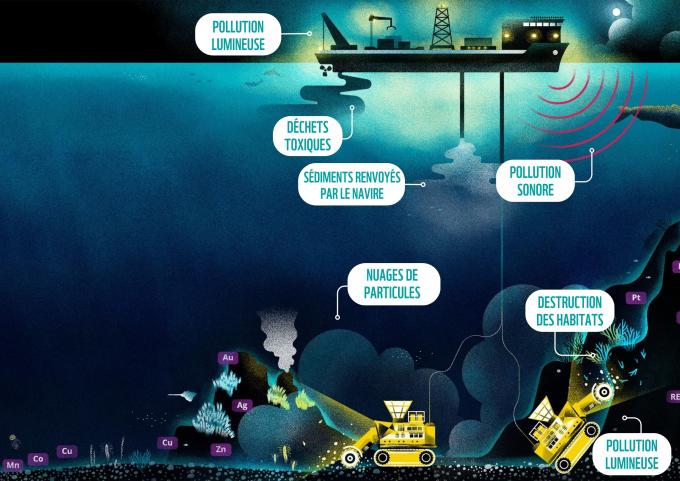 The risks of mining in this area are no less significant. Some of the expected negative impacts include:
- Loss of biodiversity: The destruction of the seafloor could threaten the survival of unique species.
- Pollution: Sediment disturbance could disrupt marine food chains.
- Underwater noise: Mining activity could cause stress in marine mammals and other noise-sensitive organisms.
- Further threats to ocean ecosystems.
- Climate upset: The ocean acts as a carbon sink (absorbing and storing carbon), and as such, it plays a fundamental role in climate regulation through animal and plant plankton. By disrupting these natural dynamics, mining could release enormous amounts of trapped carbon, thereby contributing to global warming.
Conclusion
One thing is certain: the seabed is rich in metals. However, nations are deeply divided: a growing coalition of countries is calling for caution—or even a moratorium or ban—due to a lack of sufficient scientific knowledge, while others advocate for rapid exploitation for economic and strategic reasons. This opposition complicates international negotiations.
Mining companies are eager to begin exploitation as soon as possible, while other industrial and financial players are in favor of a moratorium, particularly in the absence of adequate environmental safeguards.
In conclusion, environmental NGOs take a leading role by alerting the public to potential ecological risks and influencing public opinion and decision-makers.
In the realm of science, it is commonplace to say: ‘Be cautious. This is a venture into the unknown.’ The seabed shows no mercy. Accuracy must be 100%!
Reference
- Gregory Fléchet, L’océan, cet inconnu, Carnet de sciences, no. 18
- Évaluation de la diversité et de l’environnement des zones à nodules. Voir https://tinyurl.com/nodules-ocean
- Ex-Rio Tinto CEO’s deep-sea mining firm to merge with Odyssey in $1 billion deal | Reuters, 08 April 2026
- Le Conseil scientifique consultatif des Nations unies, Note du Conseil scientifique consultatif sur l’exploitation minière des fonds marins, New York, 09/2025
- Lundaev, Vitalii, et al. “Review of critical materials for the energy transition, an analysis of global resources and production databases and the state of material circularity”, Minerals Engineering 203 (2023): 108282
- Calderon, J. L., et al. “Critical mineral demand estimates for low-carbon technologies: What do they tell us and how can they evolve?” Renewable and Sustainable Energy Reviews 189 (2024): 113938
- International Seabed Authority, “Technical Study 32. Study of the potential impact of polymetallic nodules production in the Area on the economies of developing land-based producers of those metals which are likely to be most seriously affected,” (2022), disponible sur https://www.isa.org.jm/publications/21773/
- E. Silva, “Deep sea mining initiatives expanding to reach national waters”, S&P Market Intelligence Report, Janvier 2024, disponible sur : https://www.spglobal.com/marketintelligence/en/news-insights/latest-news-headlines/deep-sea-mining-initiatives-expanding-reach-tonational-waters-80049135
- STOP à l’exploitation minière en eaux profondes – Greenpeace Canada, www.greenpeace.ca
- https://www.unep.org/resources/publication/deep-sea-mining. Voir aussi Deberdt, Raphael, et Cara BG James. “Self-governance at depth: The international seabed authority and verification culture of the deep-sea mining industry.” Resources Policy 89 (2024) : 104577.
Comments on the March article Copper, the Staple
“Thank you for the March 2026 article! Congratulations! You are improving. Just a few comments for improvement one the general copper production schedule: 1. Regarding the sulphide minerals, needs more precision. 2. Thanks for reading Rubbers. Please also read Coackley, Prof Mabi Mulumba, the World Bank Reports and others to understand the past of our mining industry in order to chart the way for the future and not repeat the same mistakes. In that vein, I will soon publish in one month and half at Amazon a book on DRC, encompassing the mining industry. 3. On the usage of copper there are more than the copper wiring as you have shown though: Electrical & Electronics – ~60%, Building & Construction – ~20 to 25%, Transportation – ~ 10 to 12%, Industrial Machinery & Equipment – ~ 7 to 8%, Consumer & Other Products – ~3 to 5%. As a developing country, we should aim at transformation and producing goods for electrical and electronics. Again, well done on March 2026 publication !” Mr. Akili, South Africa
“Good article indeed written to make a normal person understand all about copper.” Christian Luhembwe, South Africa
“Copper is critical. 1. Skyrocketing demand: Global demand for copper is expected to increase by more than 40% by 2040, driven by electrification, electric vehicles, renewable energy, and digital infrastructure. 2. A central role in green technologies: Copper is essential for electric vehicle motors and batteries. solar panels, wind turbines, smart grids, data centers, and AI. It is literally the backbone of the electrified economy. 3. A risky geographic concentration: more than half of the world’s reserves are found in just five countries—Chile, Australia, Peru, the DRC, and Russia. This concentration creates geopolitical vulnerability. 4. Supply failing to keep pace with demand—80 new mines and $250 billion in investment would be needed by 2030. Delays in bringing mines online, declining ore grades, and environmental constraints are exacerbating the strain. The IEA classifies copper as a critical mineral, as it is essential for decarbonization and electrification. Without it, there can be no upgraded power grids or electric mobility (globalshift.ca). Even governments, such as Quebec’s, include it on the list of critical and strategic minerals necessary for the energy transition” Oscar Mbaya, Canada
MRK Mining
Un bulletin mensuel d’actualités du secteur minier produit par
A monthly mining news bulletin produced by
Margaret Rashidi Kabamba
Traductrice & Écrivain
Translator & Writer
Tel. : +1 647 767 8621
+243 83 292 5377
MRK Mining
Pour les miniers et les adeptes de la mine et des batteries pour
VE
For miners and mine and battery enthusiasts for EV